4 principaux types d'automates programmables : différences, applications et comment choisir l'automate, l'IHM et le variateur de fréquence adaptés à votre système
Jul 10, 2026
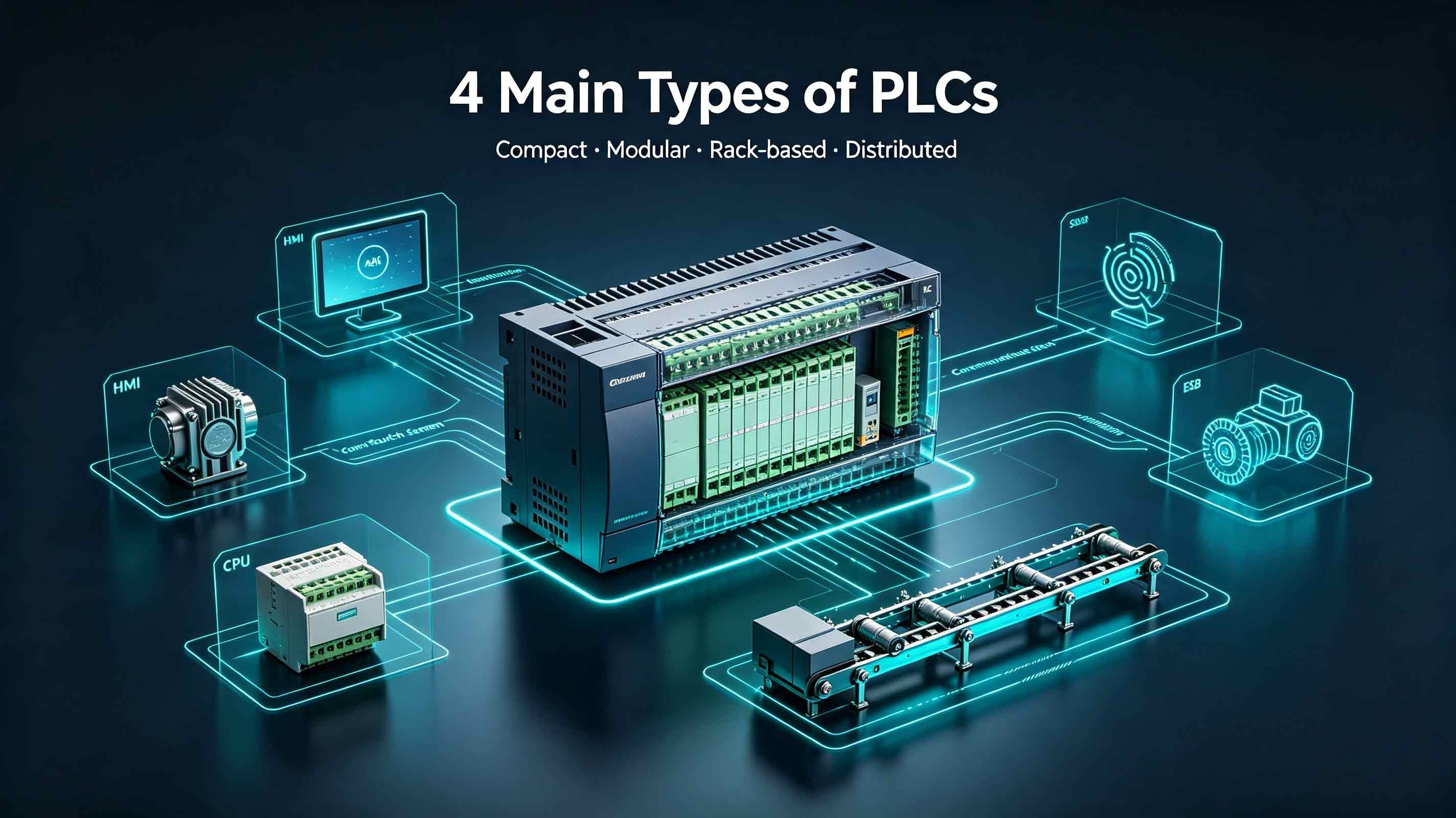
Les automates programmables industriels (API) constituent le cœur des systèmes d'automatisation industrielle modernes. Ils collectent les signaux des appareils de terrain, exécutent des programmes logiques et pilotent les actionneurs, les moteurs et autres équipements des lignes de production. La taille des projets, l'environnement d'installation et les contraintes budgétaires nécessitent des API différents. Comprendre les principaux types d'API permettra aux ingénieurs et aux acheteurs en automatisation de faire les bons choix.Quels sont les 4 principaux types d'automates programmables industriels (API) ?1. Automate programmable compact/nanoLes nano-PLC compacts sont des contrôleurs tout-en-un de petite taille dotés de ports d'E/S intégrés. Ils se caractérisent par des dimensions compactes, un câblage simple et un faible coût.Plage d'E/S typique : 10 à 64 pointsApplications courantes : petites machines, équipements d’emballage, convoyeurs simples, automatisation d’ateliers à petite échelle.Caractéristique : Extensibilité limitée, idéale pour les équipements autonomes simples.2. Automate programmable modulaireL'automate programmable modulaire est le type le plus répandu sur les sites industriels. Il se compose d'une unité centrale, de modules d'E/S numériques/analogiques séparés, de modules de communication et d'alimentations. L'utilisateur assemble les modules en fonction de ses besoins réels en E/S.Plage d'E/S typique : 64 à 1024 pointsApplications courantes : chaînes de montage, systèmes de manutention, automatisation d'usines de taille moyenne.Caractéristiques : Extension flexible, nombreuses options de communication, maintenance sur site pratique.3. Automate programmable en rack / à grande échelleLes automates programmables industriels (API) de grande taille, montés en rack, sont conçus pour les projets industriels complexes et de grande envergure. Plusieurs racks peuvent être connectés entre eux pour prendre en charge un grand nombre d'entrées/sorties, ainsi que des fonctions de processeur et d'alimentation redondantes.Plage d'E/S typique : plus de 1024 pointsApplications courantes : usines chimiques, stations d’épuration, fabrication à grande échelle, automatisation d’usines complètes.Caractéristiques : Haute fiabilité, prise en charge de la redondance, communication multiprotocole, convient aux processus critiques fonctionnant 24h/24 et 7j/7.4. Automate programmable distribuéLes systèmes PLC distribués placent les modules d'E/S distants à proximité des équipements de terrain, connectés à l'unité centrale via un bus de terrain industriel tel que Profinet, Modbus-TCP ou EtherNet/IP. Cela réduit les coûts de câblage longue distance.Applications courantes : grands ateliers avec équipements dispersés, entrepôts logistiques, équipements miniers, sites de production éloignés.Caractéristique : Réduction des coûts de câblage, collecte décentralisée et pratique des signaux de terrain.Facteurs clés à prendre en compte lors du choix d'un automate programmable pour votre projetOutre le type d'automate programmable, vous devez évaluer les points suivants avant d'acheter :Quantité totale d'E/S numériques et analogiques requises, et besoins d'extension futursProtocoles de communication industrielle pris en charge (Profinet, Modbus, EtherCAT, etc.)Environnement de travail : exigences en matière de température, de vibrations et d'étanchéité à la poussièreBudget du projet et assistance après-venteAssocier l'automate programmable à l'IHM et au variateur de fréquenceUn système d'automatisation complet ne peut reposer uniquement sur un automate programmable. L'interface homme-machine (IHM) assure le fonctionnement visuel et la surveillance des données, tandis que le variateur de fréquence contrôle la vitesse du moteur pour une régulation écoénergétique. Lors de la conception de votre système, veuillez vérifier la compatibilité entre l'automate programmable, l'IHM et le variateur de fréquence.Où trouver des automates programmables, des interfaces homme-machine et des variateurs de fréquence fiables ?Nous fournissons une gamme complète de produits d'automatisation industrielle : automates programmables, interfaces homme-machine, variateurs de fréquence et accessoires. Nous distribuons la plupart des grandes marques internationales, ainsi que des alternatives locales performantes et économiques. Que vous ayez besoin d'un nano-automate compact pour les petites machines ou d'un automate programmable en rack pour des projets d'usine complète, nous vous proposons des solutions matérielles adaptées à des prix compétitifs.Mots de la finChoisir le bon type d'automate programmable est essentiel pour un fonctionnement fiable de votre système d'automatisation. Les automates compacts, modulaires, sur rack, de grande capacité et distribués répondent chacun à des besoins spécifiques. N'hésitez pas à nous contacter pour toute consultation technique ou demande de devis concernant votre projet d'automatisation.



 Réseau IPv6 pris en charge